I am grateful to grateful to Fabio Dominski in Brasil for translating these definitions of physical activity into Portuguese. The added imagery also accentuates the differences between them. An English version is coming soon too!
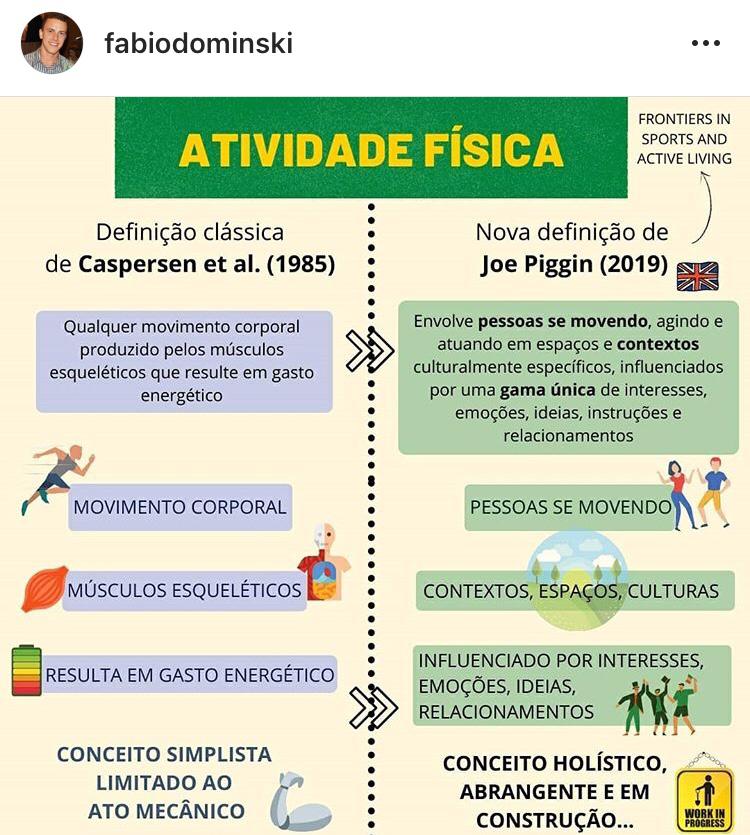
I am grateful to grateful to Fabio Dominski in Brasil for translating these definitions of physical activity into Portuguese. The added imagery also accentuates the differences between them. An English version is coming soon too!
When this Covid pandemic finishes, you might be thinking about which sports will be best for your child. Well, rugby is clearly enjoyable for many people, and is helpful for fitness and socializing (though of course most other children’s sport have similar benefits). Rugby, apparently, has also been “building character since 1823“, according to the global governing body.
But if you are thinking about encouraging your child to play rugby, do consider this new research which shows an alarming rate of concussion (brain trauma / brain injury) in school students who play rugby. In a study of 416 New Zealand high school rugby players, “the findings indicated that 69% of players had sustained a suspected concussion” during their playing of the sport at school. Did you read that properly? 69%? Really? Does that seem high?
You may be shocked at these stats. And if you’re a staunch rugby defender, you may be very skeptical about this research. Let’s go through some potential issues:
You might think it was done by biased researchers with an anti-rugby, anti-risk agenda. But, actually, of the 8 researchers involved, 4 work for New Zealand Rugby, including the “lead” researcher. The other 4 researchers work for various universities.
You might think the children are exaggerating when reporting their brain injuries. But actually, we can infer the number of concussions could be even higher than the reported figure, for two reasons. First, the researchers state: “NZ Rugby has a mandated 21 or 23-day stand-down period if a player has been removed for a suspected concussion depending on their age. While this policy prevents players with a suspected concussion from returning which is an important safety consideration, it may also have the detrimental side effect of increasing nondisclosure in players.”
Second, the researchers state “the responses of the current sample may not include the characteristics of players who have withdrawn from rugby participation due to concussions or the risk of possible concussions.” So for anyone who thinks the 69% is overstating the issue, it might reasonably be that 69% is an understatement.
You might think the “suspected” concussions reported by the participants weren’t always diagnosed by a doctor – it was sometimes only the children’s views about specific concussion symptoms. Well, 31% of participants did receive a medical diagnosis of concussion, which is still very high, right? So should we give the benefit of the doubt to the other children and adolescents who participated in the research? We may as well, right?
You might be angry about this perceived attack on one of the great sports in [insert your country here : ) ]. If so, have a chat to children who you know and see what they think about this research.
You might not be able to access the article because you’re not at a university and it’s behind a paywall. If that’s the case, you could email the researchers to inquire about a free copy! Or pay the journal £34 to get access to the article! Or lobby the government that you as a (probable) tax payer, deserve access to research conducted on school children by sports organisations and universities!
Should we agree that no matter how fun and “character building” an activity is, if it imposes a 69% concussion rate risk during a student’s schooling, there should be some serious reviews? If you disagree, what’s your “acceptable risk”? Is 50% of children having a traumatic brain injury acceptable? Or 49%? I wonder what percentage of the children themselves think is tolerable when it come to traumatic brain injury in school sport.
Joe P
As I wrote about in my recent book, physical activity is deeply political:
“Promoting physical activity requires suggesting (and sometimes dictating) what people do with their time, their money, their bodies and their minds. By espousing meanings of, reasons for, and policies to promote physical activity, a vast array of experts, from policy makers to academics and health promoters are, without hyperbole, engaged with the meaning of life.”
It’s unusual to emphasise something in parentheses, but
so unusual has this pandemic been,
so devastating the effects,
and so wide-ranging the interventions, that it is worth reflecting on.
The first three months of this pandemic has exposed many failures by governments to implement good policies to combat the virus. At the same time, the ways physical activity is organised and arranged has been the subject of intense debate. Here’s a rough chronology …
Concrete interventions deployed to keep people from moving too close. Rules, signs, instructions all deployed to manage people and their movement
Tensions between “stay at home” messages and “exercise for health” messages
The rationale of being active for “mental health” being emphasised by many spokespeople, seemingly to alleviate the built-up tensions of people confined for too long.
Anecdotal increases in people exercising in parks, with police required to manage belligerents who are not exercising (enough)
Anxiety about social distancing (which should really be called physical distancing).
The subsequent guilt of being out for too long, or shaming of those who are out for too long
Possible annoyance at others not remaining distant enough.
Possible shaming of those seen to be flouting the rules.
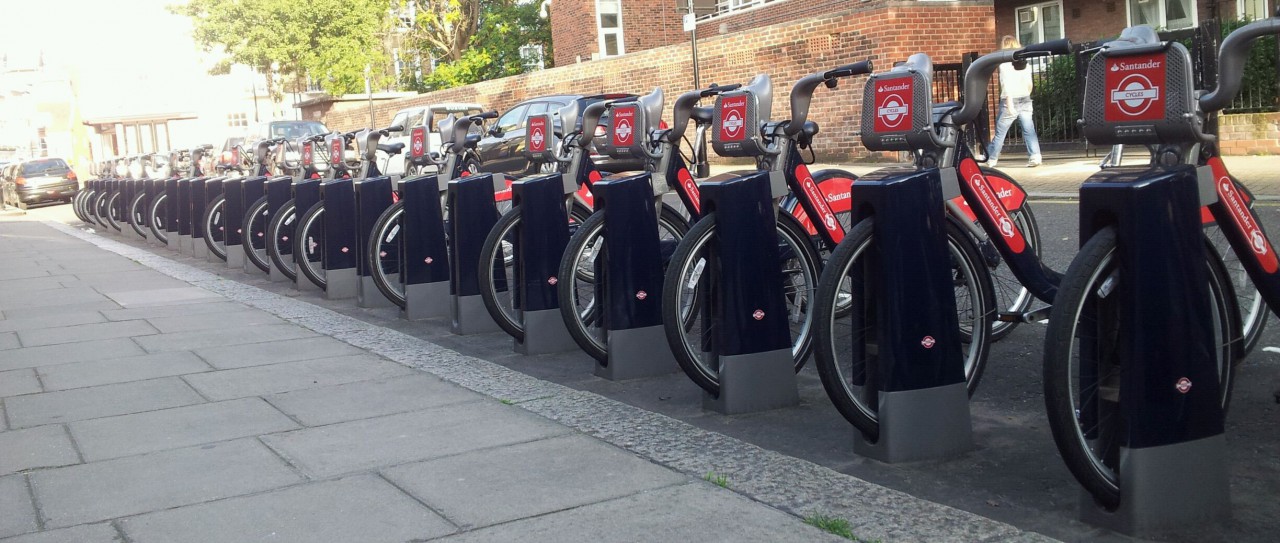
Urgent revisions made to cycling routes and pedestrian routes in some cities.
The erosion of at least some goodwill about distancing.
Academics have also responded. For example:
A litany of programmes and promotion material to get people active during lockdown
Academic journals dedicating issues on future of sport (in Managing Sport and Leisure and European Journal of Sport Management)
Intense questions about whose authority counts. For example, criticisms of lockdown “PE” on youtube
Most recently, in Ireland, “young people are being asked to choose having sex online or over the phone to stop the spread of Covid-19.”
The imposition of various degrees of limitations on all of us, and the transgressions that will inevitably occur will be testing for everyone. It is undoubtedly the case that we all need to manage our physical activity in different ways for the (un)foreseeable future. This will require heightened attention to sympathy, tolerance and respect for our own physical activity AND inactivity, as well as others’. Good luck to us all!
Joe Piggin
Unfortunately people move, act and perform for all sorts of awful, harmful, destructive reasons.
It’s physical assault by bullies, thugs and criminals.
It’s peer pressure from body shamers.
It’s using exercise to punish children.
It’s 69% of children getting concussion from a school sport.
It’s your golf game during a pandemic.
It’s commuting employees putting themselves in harm’s way.
It’s marching for a racist ideology.
It’s “law enforcement” shooting children dead and police brutality.
It’s worker exploitation.
So there is nothing inherently good about moving your body. We need to advocate and promote positive movement. Since we imbue movements with specific goals and meanings, we need to look out for and confront physical activity which oppresses and marginalizes. We need to condemn activities which hinder the flourishing of human potential.
GUEST CONTRIBUTION: Matthew ‘Tepi’ Mclaughlin, @HealthTepi, PhD Candidate @Uni_Newcastle Chair ISPAH Early Career Network
‘It’s a lockdown, but don’t stop exercising’ is the message from the UK Government during the Coronavirus pandemic of 2020.
On the back of this stance, a few people have been quick to suggest this may increase the nation’s physical activity. Or it could go the other way.

I suggest it will decrease during lockdown.
Personal Case Study of the Mclaughlin Family
Our family unit currently consists of myself and my parents, whilst I am home from Australia (where I am doing my PhD and live with my fiancée).
Dad works at a busy café, regularly sending me screenshots of how he’s done 10,000 steps whilst at work. The café is closed due to the Government directive.
Mum’s a gym bunny, her classes have closed at the gym.
I cycle 26km a day commuting to work, I now walk from my bedroom to the office.
Last week, we set up home gym in the back garden. We’re lucky, we could afford the equipment. We have the skills to set up a safe exercise circuit. We’re all motivated. We don’t have children to look after. We have a back garden. The weather has so far been kind.
We’ve been out each day since.
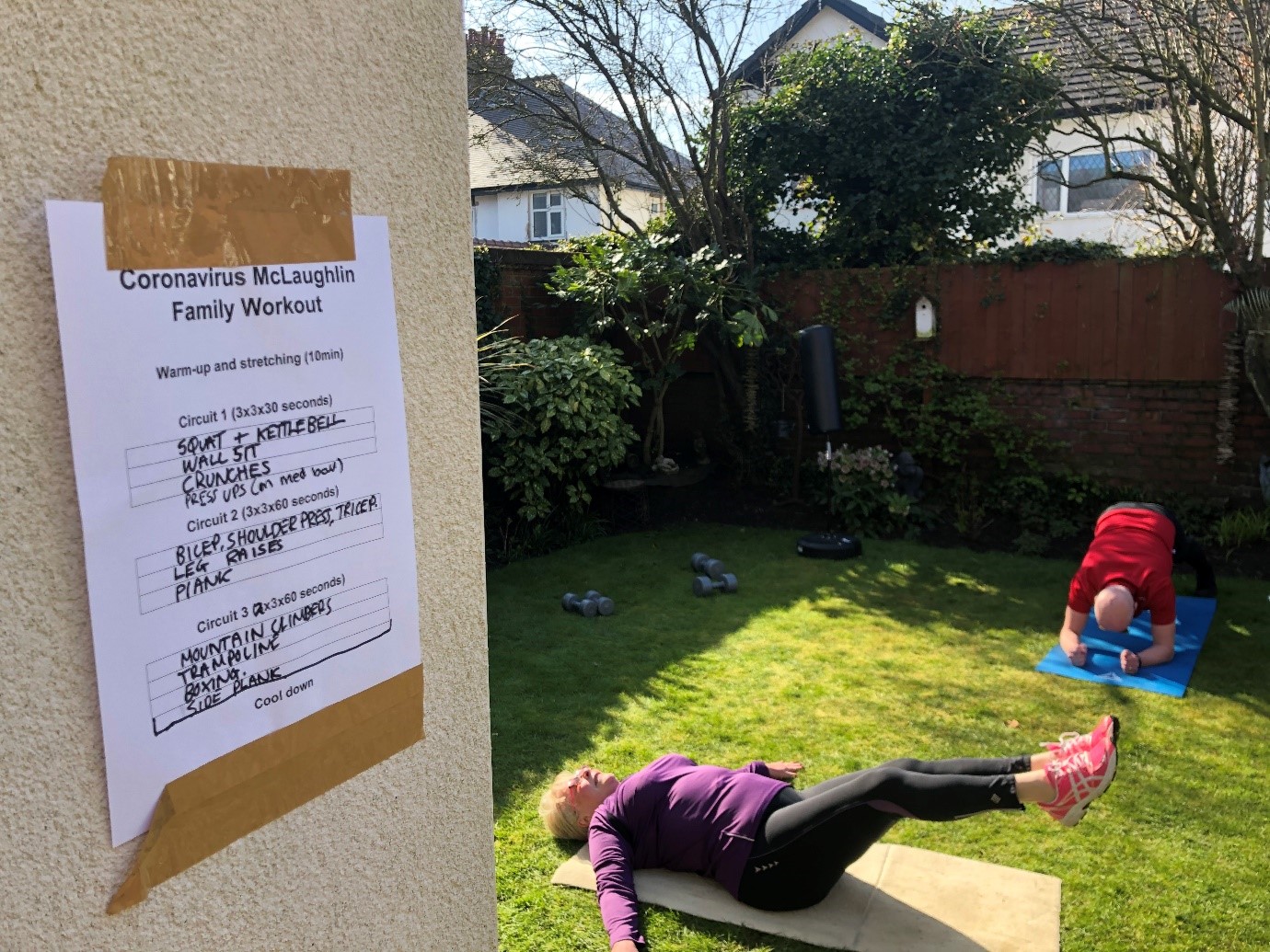
So yes, it may appear we’re ‘exercising’ more….but I suggest we’re doing less overall physical activity during this pandemic. Between us, we’re doing less active transport and less occupation-related physical activity.
Some reasons why we won’t be more active during this pandemic
Reason 1: We might exercise more during our leisure, but we’ll do less active transport and work related physical activity.
Reason 2: Gyms are closed, so exercise routines are disrupted.
Reason 3: The privileged might, but others won’t exercise more.
Reason 4: Many of us have been instructed to leave the house under no circumstances, not even for exercise
**NEWS FLASH**
Data from Fitbit suggests a decline in step count last week of 9% in the UK compared with the same time last year. It looks as though I was right, unfortunately.
Post the Coronavirus pandemic, will physical inactivity be recognised as a pandemic?
Possibly.
In the long term, this may have some unanticipated benefits. The ‘stage’ that physical activity has been given by politicians is bigger than ever, just by being mentioned. The negative emotions people feel from this lockdown may last, people may attribute them to “not getting outside” or “not moving about”. I suggest Dr Karen Milton may be right:

Today was the first day of the British “lockdown”. Seeing the devastation wrought upon countries such as China, Italy and Spain, the UK government has finally(!) taken more serious steps to overcome the Coronavirus. Their official advice is below.

While the advice / rules are generally clear, there is still some confusion – for example, what counts or what does not count as essential. More detailed advice about leaving the house was provided in a document on the government’s website:

In reply to a journalist’s question about how much running, cycling or walking people should do each day, one government minister replied that they should do what “ordinarily would have done”. So if this advice is followed, there won’t be an upsurge in the nation’s physical activity levels, since many/most in the population don’t ordinarily meet government guidelines for physical activity anyway.
After more than a week of very limited movement outside of home, I decided to go for a walk after lunch to a local park. Here’s my thoughts on that. Rewatching the video I noticed I said the UK government still “encourage” exercise … but in hindsight, that was probably too strong … “allow” exercise is probably closer to the truth!
Part 1: Avoiding Other People
Part 2: At the Park
Part 3: The End of the Walk
I am not sure what the future holds for these sorts of excursions. It looks like the situation in the UK `is only getting worse with more than 80 people dying today from the virus. It is quite possible even walking, running and cycling for exercise will need to be eliminated for a while. Keep safe everyone!
Joe P
I was honoured to discuss some analysis on a proposal for a more inclusive, expansive definition of physical activity during a webcast:
Here I recount some interesting developments in the reporting of injury risk in rugby union. Enjoy (and be concerned!)
Why is so much attention given to physical activity? Why do we care about it? Why is it in policy?
To answer this, in my book, I argue that we should think of physical activity as a specific political discourse. Discourses are forms of knowledge, so they govern the way a topic can be meaningfully talked about or reasoned about, and they influence how policy ideas are put into practice. So instead of thinking about physical activity simply as human movement, from a policy perspective it is much more than that. Here is a brief explanation of my thinking …
The physical activity discourse, I argue, has not emerged out of nothing. Other discourses, like ingredients, have facilitated the escalation in physical activity’s rise to prominence and legitimacy. For example, consider the obesity epidemic which has framed human bodies as susceptible to specific judgement and surveillance (see Gard and Wright, 2005). The rise of surveillance technologies which affect both leisure and work has allowed physical activity to be measured ad infinitum (and ad nauseum).
Of course, the discourse does not necessarily appear with all these ingredients. It needs a raft of committed “bakers” who will devote time and attention to escalate and seek legitimacy for the physical activity problem. Networks are needed, most obviously manifesting as scientific associations of physical activity. And along with these scholarly societies come links to industry and the state.
And after scientific elements establish legitimacy, the physical activity discourse is continually built upon and deployed in different spheres, with frontiers in all directions. Indeed, this framework for thinking about the physical activity discourse is not intended to be static. There will be specific contexts which frame physical activity in unique ways. That is part of what makes the discourse a potentially powerful policy driver. Its hybridity and its potential omnipresence as a matter of concern (affecting all domains of human life) means that it can be potentially infused into all sorts of policies.
The model below shows how a range of “forms of knowledge” work together (and / or separately) to produce what we know about physical activity (particularly in many Western, developed societies).

While I suggest biomechanics is an essential discourse, it does not carry a great amount of disciplinary weight when physical activity is researched, analysed or justified. Human movement without values added is not enough to produce and sustain the physical activity discourse. More influential is the biomedical discourse, which has made connections between physical activity, health, and death rates. (There’s more in the book on this!). Various sustaining discourses shown above allow for physical activity to be deployed at different times in texts, policies and programmes by a wide array of different organisations. You can see “health” is only one of many discourses that sustains current concern about it. Many other discourses contribute now too.
This discourse has real implications. Correlating insufficient physical inactivity with all manner of economic, health, environmental, and inter-personal outcomes leads to a number of flow on effects, including the production of new experts, new expectations, authoritative organisations and specific ideas about social order.
I argue that by seeing viewing physical activity in this way – as a discourse made up of the interplay of other discourses (and not simply as a means to promote public health) – we might better appreciate how the swirling and growing mass of concern about physical activity affects us all.

The Politics of Physical Activity REFERENCES
Joe Piggin
 Physical Activity Politics