Me, sport and sugar

I grew up in New Zealand, in a loving family, with plenty of outdoor space to roam around in, and plenty of sport to play. Oranges at half time in soccer were the nutritional order of the day. I enjoyed my cross country running, after which I would quench my thirst from my favourite yellow flask.

Raro
My post-cross country flask

Sometimes, “Raro” powder would be added for some flavour. You can still buy this.

Raro-Sachet-Navel-Orange
Credit: Countdown supermarket

Then, with the increasing professionalisation and “scientisation” of sport and exercise, came an increasing prominence of sports drinks. In New Zealand, it was Powerade. In the 2000’s I was into my long distance running and triathlons so I was guzzling about 3 of these a week for many years (and they weren’t cheap!).

Powerade
My favourite Powerade and my cool brother Ol

We were told Powerade was “isotonic” and could rehydrate you for optimal performance. I always assumed it made a little bit of a difference, but to be honest, apart from the nice taste, I never felt quantitatively better for it. I wonder if I was supposed to be able to feel a difference after drinking it.

Powerade 2
A rough guess at my lifetime Powerade consumption – around 400 bottles. (Photo credit @paintchitownred)

In hindsight, was all that sugar worth it? In terms of performance, I suspect the differences were marginal at best. See this British Medical Journal report for more interesting analysis of the questionable promotion of sports drinks.

More broadly, with sugar-food companies dominating sports events with their branding and products, I wonder about the role of sport managers (and sport management academics) in this nexus. I wonder what role sport management has to play in this apparent health problem of over-consumption. What trade offs are made between “professional practice” and health enhancing practice? How should sport management practitioners negotiate this increasingly tricky situation? There does not appear to be any Codes of Ethics on sites such as the European Association of Sport Management or the Sport Management Association of Australia and New Zealand.

Here is a Code from the North American Society of Sport Management. While well-intentioned, I wonder how some of these ideals are put into practice, particularly when researchers try to find ways to enhance brand identities and increase revenue for sponsors. For example, point “S” states that “The sport manager should promote the general welfare of society.” I wonder to what extent sport managers consider their associations with companies that sell calorie-rich, but nutrient-poor food.

Joe P

Academics, Physical Activity and Ethics: The Declarations

This post is written in haste but I have been thinking about ethics since I started this blog. In the last couple of hours an article has been exposing more than was previously publicly known about Coca Cola’s involvement with physical activity promotion. It is worth reading.

It is clear that the PA community is not currently united about ethical practice. Recent events give an impetus for the academic community to prioritise critical thinking about “advocacy”, “vested interests” and “conflicts of interest” in physical activity research and promotion.

Therefore, here are 4 declarations for ethical PA academic practice. I hope ideas like this guide the academic PA community. They are not exhaustive. I welcome additions.

1. Physical activity researchers and promoters must critically investigate the background of the funders they seek money from.

2. As producers of knowledge, PA researchers are in a powerful, privileged position.  The PA community must automatically treat funders with skepticism.

3. Those involved in PA curriculum design and teaching must give immediate attention to “ethics” in their courses. They must make ethics a compulsory component of the qualification and find suitably qualified people to teach this.

4. PA journals and conferences must foreground themes of “ethics”, “conflicts of interests” and “vested interests” in their publications and events.


Joe Piggin

For more, see:
Piggin, J & Bairner, A (2016) The global physical inactivity pandemic: An analysis of knowledge production. Sport, Education and Society. 21, 2. 131-147.

A response to an editorial in the Journal of Physical Activity and Health

We were very disappointed to read the editorial in the recent issue of the Journal of Physical Activity and Health, written by the journal’s Editor-in-chief. The editorial is entitled “Corporate-Sponsored Obesity Research: Is Sugar Really Coating the Truth?”.

The editor, Prof DiPietro, criticises a NY Times article which itself criticised the Global Energy Balance Network. In our view, her editorial contains an unfortunate mixture of hyperbole, poor logic and short-sightedness. We contend that the arguments presented by DiPietro do little to enhance readers’ understanding of the political and economic forces that are involved when corporations sponsor physical activity research and promote physical activity to populations. Here are our main concerns, underneath extracts from DiPietro’s editorial:

1.

DiPietro: “The [Times] article, titled “Coca-Cola Funds Scientists Who Shift Blame for Obesity Away from Bad Diets,” goes out of its way to discredit the GEBN due to its funding source” (p. 745, 2015).

Our Response: The article does not “go out of its way to discredit the GEBN”. It provides a variety of evidence and sources to highlight significant issues with the GEBN. This is investigative journalism. The journalist has quoted the GEBN and people affiliated to it; so for want of a better description, it is actually a “balanced” article.

There have been major ramifications as a result of the Times article being published. For example Steven Blair asked that his “video addressing energy balance be taken down from the GEBN website” … and wrote “My dismissal of diet as a cause of obesity did a disservice to [top nutrition experts’] work” (Blair, 2015). Also, Coca Cola has been pressured into being more transparent with regard to their sponsorship of research and promotion of PA and health.

DiPietro’s accusation actually impugns the integrity of those involved in the Times article, for which an apology might be appropriate.

2.

DiPietro: “The science leading to these [energy flux] conclusions was not funded by Coca-Cola or any other industry and it proposes that weight regulation is best achieved at levels of high energy expenditure plus matching energy intake and low energy storage. There are numerous scientists around the world who support this claim that are also not funded by the food or beverage industry. Sadly, this message was distorted rather remarkably in the Times article, which indicated that the GEBN feels that “diet is not important.” (p. 745, 2015).

Our Response: Given Steven Blair’s initial comments in the now-retracted video, and his subsequent statement about the disservice he had done, it is clear that Blair, not the Times article, was the source of significant distortion.

DiPietro fails to identify specific instances of where the “distortions” she claims actually occur in the article. We can find a reference to the GEBN’s Dr James Hill: “On its website, the group recommends combining greater exercise and food intake because, Dr Hill said, “ ‘Eat less’ has never been a message that’s been effective. The message should be ‘Move more and eat smarter.’ ” (p. 745, 2015).

So from our interpretation, the Times article does not distort a message about “energy flux” – it actually quotes the GEBN’s spokesperson James Hill making a statement about it. Therefore we suggest DiPietro might be (hopefully unintentionally) misleading readers.

Conclusion: We challenge DiPietro to identify specific instances of where the “distortions” she claims actually occur in the article.

3.

DiPietro: [Regarding weight loss and weight regulation] “If the Times article had solicited input from scientists not affiliated with the GEBN who were also experts in exercise and metabolism (rather than only experts in nutrition), this message might have been conveyed more accurately” (p. 745, 2015).

Our Response: The Times article actually featured responses from: Michele Simon, a public health lawyer; Dr. Yoni Freedhoff, an obesity expert at the University of Ottawa; Barry M. Popkin, a professor of global nutrition at the University of North Carolina at Chapel Hil; Professor Marion Nestle, professor of nutrition, food studies and public health at New York University; Dr. Anne McTiernan, a cancer prevention researcher at the Fred Hutchinson Cancer Center in Seattle; Professor Kelly D. Brownell, dean of the Sanford School of Public Policy at Duke University; Link to research from: Professor Aaron E. Carroll, a professor of paediatrics at Indiana University School of Medicine.

To suggest that the Times article needed “experts in exercise and metabolism (rather than only experts in nutrition)” does a disservice to the Times article, which was clearly not focused on ideas about energy flux, but rather the political economy of obesity and physical activity research. DiPietro focuses on micronutrient systems, rather than macro-political systems, while the Times article clearly focuses on the latter.

4.

DiPietro: “Another source of contention in Times article [sic] is the perceived conflict of interest as a result of taking money from an industry that may have a vested interest in the very nature of your findings. The implicit concern is that the scientific findings will waver from truth and toward benefitting that very industry” (p. 745, 2015).

Our Response: There is no “implicit concern” with conflicts of interest in corporate funded research. The Times article is explicitly concerned with conflicts of interest.

Further, there is no “perceived” conflict of interest in this case. There is an actual conflict of interest. To be clear, for a conflict of interest to occur, it is not necessary to show that a sponsor is using its position to further a particular cause. It is enough that there is a perceived conflict of interest before data is even gathered. We encourage PA researchers to act with extreme caution regarding sponsored funding. We wonder if the International Society for Physical Activity and Health might be able to provide ethical guidance to researchers who want to avoid such conflicts of interest.

5.

DiPietro: “The implicit concern is that the scientific findings [sponsored by the GEBN and Coca Cola] will waver from truth and toward benefitting that very industry. If that were really the case, however, why do we not express equal outrage and judgment of studies funded by pharmaceutical companies? (p. 745, 2015).

Our Response: Of all of DiPietro’s comments, this is the most concerning. DiPietro’s logic is faulty in several respects. Sound reasons why there might not be “equal outrage and judgment of pharma” include:

  1. A lack of transparency by companies leading to a lack of understanding by consumers
  2. A lack of perceived influence on the part of consumers
  3. Different tactics employed by concerned consumers
  4. A lack of resources available to citizens

There are a number of other concerns about DiPietro’s comparison. The two contexts of obesity research and pharmaceutical research need to be examined on their own merits. The pharma industry, despite profit motives and examples of dubious drug effects, has far more merit than Coca Cola as a mechanism for saving lives and reducing pain and suffering. The pharma industry has a long history of contributing to health and wellbeing, which can scarcely be said of the soft drinks industry.

Most importantly, downplaying conflicts of interest in obesity/PA research because consumer engagement in another industry is addressed differently is alarmingly simplistic. We wonder, therefore, if editorials in JPAH should be peer reviewed to avoid such worrying causal leaps. We certainly hope that this faulty causal logic is not endorsed by the Journal of Physical Activity and Health in its reviewing process.

Also, actually, for many years there has been protest directed at pharmaceutical companies, much of which is synthesised at Ben Goldacre’s website, Bad Science badscience.net and in Jacky Law’s (2006) book, Big Pharma. This protest may not be as large or as apparent as the recent Coca Cola scandal, but to downplay the protest that does occur, as DiPietro does, is problematic.

The Times article which DiPietro critiques clearly points out that “A recent analysis of beverage studies, published in the journal PLOS Medicine, found that those funded by Coca-Cola, PepsiCo, the American Beverage Association and the sugar industry were five times more likely to find no link between sugary drinks and weight gain than studies whose authors reported no financial conflicts.” We are amazed, and quite frankly alarmed that this extract from the Times article does not appear to resonate with DiPietro.

DiPietro’s conclusion is particularly alarming and we offer a challenge to her overly simplistic defence of corporate funding to be substantiated. We sincerely hope that students of physical activity, sedentary behaviour and exercise science do not draw the same conclusions about corporate involvement in health promotion as DiPietro does.

6.

DiPietro: “Although the funding disclosures were initially and unintentionally omitted from the GEBN website when it was first launched, they were added immediately when the GEBN was notified of the error.” (p. 745, 2015).

Our Response: DiPietro’s commentary here merely repeats information already in the Times article. We wonder if DiPietro is or ever has been a member of the GEBN. We seek clarity on this issue (and a response to our other challenges here).

7.

DiPietro: “Science advances in steps and the field of physical activity and health is still learning to walk. Maybe the real issue in the Times article is that one of the funders of GEBN research is Coca-Cola, the world’s largest producer of sugary beverages and in many people’s minds the source of all that is evil.” (p. 745, 2015).

Our Response: We think this comment is poorly thought out. We contend that few people think Coca-Cola is “evil”. We believe that most would acknowledge Coca-Cola for what it is, a global corporation with a stated aim and obligation to maximise a return for its shareholders. We contend that whether it is through greenwashing its products, promoting Coke to children, being charged with tax evasion, or sponsoring physical activity research (and ISPAH conferences), Coca Cola is simply acting as it is obliged to act. Therefore, accusing Coca Cola critics of thinking Coke is “evil” is a poorly thought out argument and does not give appropriate credit to the concerted efforts of activists who are concerned by the Coca Cola Company’s behaviour.

Note: DiPietro’s repeated use of the words “real” and “really” in the editorial suggest a limited understanding of the complex mechanisms to which she herself alludes in the article.

8.

DiPietro: “In today’s fiscal environment, it is extremely difficult for scientists to get their work funded. Hopefully, the government will soon decide that science is worth supporting again, and researchers will no longer need to turn to corporations with fat wallets for the funding of their ideas. Until that time, we must judge the quality of the science instead of baselessly impugning the reputations of the scientists.” (p. 745, 2015).

Our Response: If we conclude that the government implied by the Editor-in-chief is the USA government, then this is a particularly US-centric approach to editorial writing. It is unworthy of a journal that is claimed to be the “official journal of the International Society for Physical Activity and Health”. We encourage DiPietro to clarify which government she means.

At the same time, we also seek clarity on her suggestion that “science” is not currently being supported. This claim is vague.

Lastly, given the significant limitations of the editorial, we hope that DiPietro’s claim of scientists having their reputations “baselessly impugned” will be retracted in the same way that the founding editor of the JPAH (Steven Blair) retracted his video.

We welcome a response from Loretta DiPietro.

Dr Joe Piggin, with guest contributor Prof Alan Bairner

POSTSCRIPT – 2 December 2015. In an email to Prof. DiPietro, I asked:

1) Do recent media reports this week [showing internal Coke emails with Prof James Hill] lead you towards a different conclusion about Coca Cola’s involvement with the GEBN and the GEBN’s involvement with Coca Cola[?]

2) Would you consider writing a new editorial with these recent events in mind?

3)  Would you be willing to consider a short commentary for your journal on this topic? I have recently published about corporate lobbying in physical activity (see J Piggin 2014), and I would be willing to write a piece for your Journal. Please let me know.

I appreciated the response. I have reproduced the email below in its entirety:


No thank you.

 

Active and Inactive People in Policy

Health policies are often thought of as text-heavy documents combining aspirational rhetoric with references to “stakeholders”, “step changes”, “targets” and “outcomes”. Of course, it is through words and numbers that resources and budgets are decided. However, imagery plays an important (subtle) role in shaping how policy problems and solutions are defined in the first place. I offer a few examples of how imagery in physical activity policy documents can powerfully (but subtly) affect how readers of policy understand an issue.

Healthy Weight Health Lives, UK Department of Health 2008

This was a major “anti-obesity” policy in the UK, written by the Cross-Department Obesity Unit, Department of Health and Children School and Families.

Picture1
Cover Page of Health Weight, Healthy Lives, UK Government, 2008.

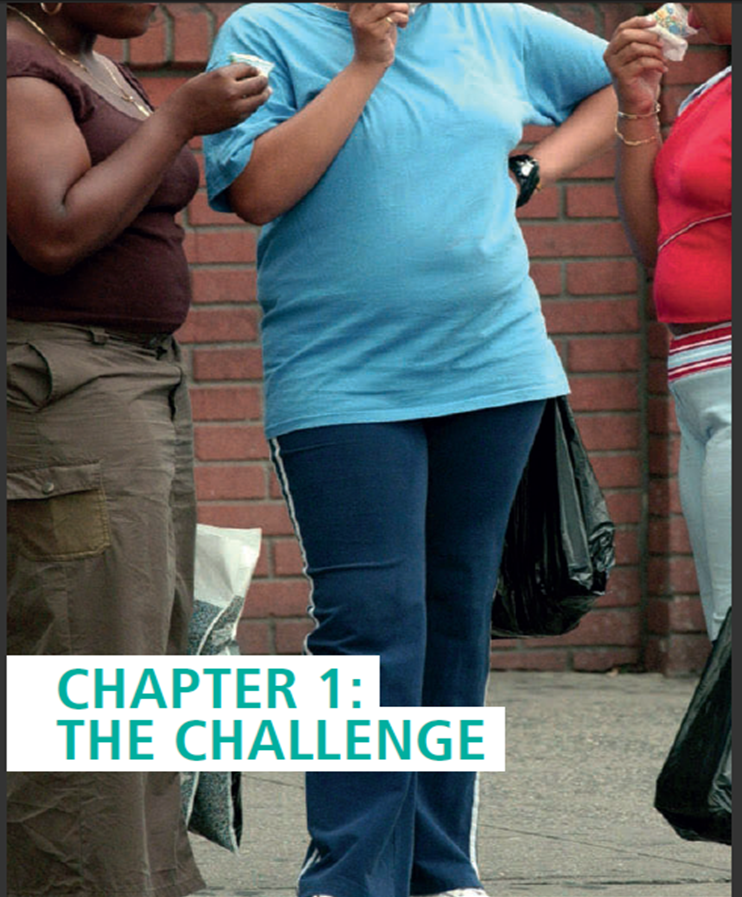
The front cover connotes leisure, pleasure, 2.0 children, freedom, fashion, and a local council with immaculate greenkeeping. A slim, active life is a good life. Now, compare that to how “THE CHALLENGE” is visualised (p. xvi).

Challenge
Image from Health Weight, Healthy Lives, p. xvi.

This image (subtly) tells UK policy readers many things. We are encouraged to look at the anonymous bodies with disgust, and to judge their ill fitting clothes, their gorging, their loitering. Why are these women not frolicking on a grassy field? Rather than judging these people, we should ask questions about the process of image production.

Q: How could “THE CHALLENGE” be framed differntly? Is it obesity? Or is it economic poverty?

Q: Why are we looking at these bodies without faces? One might argue removing the heads is conscientiousness, ensuring the anonymity of those in the photo. However, there is another reason. Deborah Thomson refers to this practice as spectacular decapitation – a powerful shaming practice. It encourages the viewer to assimilate all the surrounding signifiers (the clothes, the gorging) with the shape of the bodies to make a judgment about those bodies.

Q: Does it matter that this image is not from the UK? Tracing the photo credit reveals the image is actually from the USA. The photo is of “Overweight New Yorkers eating ice cream on West Fordham Road at Grand Avenue in the Bronx, NY on Tuesday, August 12, 2003.”

Q: More importantly, was permission sought and received from the three women involved? I suspect permission was not sought. The photo, like many others on the site, is clearly taken in a public place. If permission was not gained, does this make it ethical?

Of course, these images are only two of many in the document, but it should encourage us to consider how people are presented in official policy.

Joe Piggin

For more see,

Piggin, J. & Lee, J. (2011) ‘Don’t mention obesity’: Contradictions and tensions in the UK Change4Life health promotion campaign. Journal of Health Psychology, 16, 1151-1164.

An NFL “extended conversation” on youth traumatic brain injury is 2 mins 51 secs.

This video from the NFL is quite disturbing. The NFL calls it an “extended conversation that covers all sides of youth sports and safety.” It is actually only 2 minutes and 51 seconds of conversation, much of which is based on anecdotes from the various mothers involved.

Part 2 is also disturbing. Here a “mom” asks “What is your opinion on how many concussions is too many? For example, my son is 10. He’s already had 2.” Later, one mother says she thinks had had more concussions than her former NFL-playing husband because … “I’m only 5ft5. I play basketball. I get hit in the head so many times …”

I’m no neuropsychologist like Dr. Elizabeth Pieroth (one of the moms), but my relatively intact brain thinks that we should aim to avoid harming the brains of children. This means getting rid of full contact American football for children.

Photo from the physical activity lobby document
Photo from the physical activity lobby document “Designed To Move” (2012), which was endorsed by the NFL. However, little brains are not designed to move inside the skull.

A Great Fallacy in Physical Activity Promotion

Yes, I know the title is provocative. I believe one important “fact” about physical activity is being repeated to parents, teachers and children in schools across the USA and elsewhere around the world.  The repeated claim is that physical fitness can increase test scores by 40%. But I contend it is not a “fact” at all. It is a fallacy.

The timeline shows how this “40% fallacy” came to be.

2005

A study by James Grissom is published. I think it is quite interesting research. It evaluates the relationship between physical fitness and academic achievement. The “results indicate a consistent positive relationship between overall fitness and academic achievement” (p. 11).

But, Grissom also makes it clear that “results should be interpreted with caution. It cannot be inferred from these data that physical fitness causes academic achievement to improve” (p. 11) …. and a major axiom of social science research is that correlation is not causality. It cannot be inferred from these data that physical fitness increased or improved academic achievement. There was no time or logical ordering that automatically lead from one event to the other. It is just as logical to believe that mental capacity affects physical ability …. This study is seen as preliminary.” (p. 24).

Okay, no problem.

2012

A few years later, Nike, The American College of Sports Medicine (ACSM) and the International Council of Sport Science and Physical Education (ICSSPE), and supported by many others organisations and scientists, publish Designed To Move, a lobby document promoting physical activity. It includes this image (p. 17):
Picture3
A close up shows a claim that “Fitness is associated with 40% higher test scores” (p. 14) and a reference to Grissom’s article (you can see the little c).

Picture5

This is concerning because the title of the image infers there is an extremely large causal relationship whereby fitness leads to higher test scores. The title of the graph refers to “compounding benefits” and “a prosperous cycle” from physical activity. Remember, Grissom did not claim this. In fact, he warned against concluding from this study that physical activity leads to higher test scores.

So I had another check of Grissom’s research and I think this is the graph that Nike, the ACSM and the ICSSPE used to claim their “40% higher tests scores”. As you can see below, yes, there is a relation between the Stanford Achievement Test and how many fitness standards are achieved.

Picture6

But remember what Grissom wrote about his research. The research shows a correlation, not causation. A preliminary study. …. One could just as easily conclude that mental capacity affects physical ability. He also wrote about how socio-economic status has a large role in both test scores and fitness levels, as I am sure we would intuitively appreciate. So we shouldn’t jump to conclusions about this. 

2013

This is where the “40% higher” claim starts being used to promote physical activity around the USA. Of course, I am not arguing against PA promotion. But I am beginning to see why an organisation would want to say that physical activity can lead to 40% higher scores. Not only for more active populations. But so they can get into schools and promote it, along with their brand. This is indeed an excellent marketing strategy. For more on the Trojan horse tactics used by corporations to target children in schools, see this study by Powell and Gard.

Nike athletes and children adorned with compulsory Nike logos at a Chicago School. Source: news.nike.com

2014

Now it is the UK’s turn to hear the “40% higher tests from physical activity” claim . In the UK, in 2014, there was a physical activity campaign called “Move1hour”. (As an aside, Move1hour did have a facebook and twitter account but these have been deleted. A short lived social movement indeed!) However, you can see from the Designed To Move facebook page how the “40% increase”claim has been used to encourage physical activity. It has become fact.

Picture8

2015 

It’s August 2015 and here is Nike (of course) perpetuating this 40% fallacy.

My view is that saying children “can score 40% higher on tests” is a manipulation of the original research to the point where it is deceptive. Not intentionally deceptive. But still deceptive. I suspect that the enthusiasm of some evangelical physical activity promoters is overriding reflective, considered practice.
Joe Piggin

Some caveats: Of course there are numerous reasons to promote physical activity in schools and I appreciate many organisations are just trying their best with limited resources to promote it. But we should be wary of evangelism.

PA Lobbying – Time for a radical change

Co-operating with corporations for health promotion is problematic, despite it being a practice endorsed by the World Health Organisation. While no stranger to criticism, Coca Cola is now trying is limit the damage from this latest New York Times investigation. The Times exposes some more links between corporations and health scientists. The accompanying video is also compelling viewing. One does not need to be a critical researcher to appreciate how the repetition of “balance” in the video appears somehow … unbalanced.

It reminds me of another example of how a corporation has ingratiated itself within academia (and how academics have ingratiated themselves with corporations). In 2013, the Journal of Physical Activity and Health published an article about the wide-ranging benefits of physical activity (Bailey et al, 289). The article proposed the Human Capital Model, which theorises that physical activity can contribute to various forms of capital for an individual, including emotional, financial, individual, intellectual, physical, and social capitals. The article is “aspirational”, though it is also troubling. The “Human Capital Model” was not produced by the authors of the article, but by Nike Inc. Why is Nike, a global sportswear company, interested in publishing a theoretical model in an academic journal? The Acknowledgements section in the article suggest how the model came to be: “In 2010 NIKE, Inc. developed the Human Capital Model, informed by more than 500 pieces of published research, and initiated a multidisciplinary input and validation process with a pool of experts.” (p. 302) Nike also holds the copyright to all the models and figures in the article including Figure 4, below, which claims that Financial Capital is “reliant on the other Capitals” (p. 301): Nike Figure 1: Reproduced from Bailey et al., 2013, p. 301.

The flow chart above contains many very troubling assumptions. First, there are surely many people around the world who have high levels of financial capital without having a significant amount of physical, emotional, individual, intellectual or social capital. Even a cursory analysis of one’s own social network and community (or personal introspection!) might provide examples to show the fallacy that financial capital is “reliant on all the other capitals”.

Second, it is readily apparent that many forms of capital depend on possessing or being born into families with financial capital to begin with. At least in Western neoliberal societies anyway. We are all born into already-constituted communities. The advantages and privileges afforded by having access to financial capital are clear.

Third, the elevation of financial capital to the pinnacle of the figure implies that money is the desired outcome to be attained. Framing financial capital as the outcome of various forms of capital is perhaps the most overt display of Western neo-liberal thinking articulated in a scholarly journal on physical activity to date. Possessing any or all of the forms of capital in the model is simply a way of acquiring something else – money. Of course, Nike is obligated to make a profit for its shareholders, but we need to recall what a singular focus on increasing financial capital can lead to. In 2005, Nike’s own report of the factories that made its shoes and clothing admitted “excessively long work weeks, wrong wage calculations, verbal abuse, curbs on toilet visits” and a pervasive culture of exploitation. Nike’s admission of worker abuses occurring shows how those with financial capital can exploit those without.

Fourth, nowhere in the article is any evidence provided for the claim: “Financial capital: reliant on the other Capitals.” Should we expect higher standards from a publication in the Journal of Physical Activity and Health?

Fifth, to whom do the authors encourage this financial capital to belong? Bailey et al emphasise individual financial capital accumulation by “highlight[ing] the ways in which engagement in physical activity can act as an asset that enhances career and financial success” (p. 301). I ask, is the accumulation of financial capital a worthy goal, especially when there are such stark differences in the current global distribution of wealth?

Coca Cola, like Nike, must not only make profit, but must continually try to grow profits. Physical activity researchers must give more critical attention to these corporate imperatives, and be prepared to reject their advances despite the lure of magnificent increases in personal financial capital! Perhaps the shame of being compared to “big tobacco” apologists might encourage others to reflect on their associations with “big sugar”. I encourage you to read this incisive account of Coke at the world’s largest physical activity conference in 2014. We will wait and see if ISPAH 2016 continues to be sponsored by Coca Cola. Popular rhetoric about PA promotion calls for radical change and revolution. I end this post by calling for a radical rethinking of corporate linkages.  Watch this space – literally! Joe Piggin

For more, see:

Piggin, J. (2014) Physical activity lobbying: A critical analysis of framing global solutions. Health Education Journal. 74, 1, 16 – 27.

Welcome to my blog – Physical Activity Politics

This blog explores the emerging Zeitgeist of physical activity. Physical activity is being used by a many organisations to achieve goals such as health, productivity, social inclusion and sustainability. I consider the effects that these policies, interventions, programmes and campaigns have on how people. More specifically, the political dynamics involved in physical activity are the focus. Macro-politics, micro-politics and everything in between.

Critiques of food politics www.foodpolitics.com and obesity politics are well known. Here I examine how physical activity is laden with values and used in order to (try to) achieve particular economic, health and social outcomes.

Regards, Joe Piggin